Fringe Benefit Tax - The "ute" tax
Categories
There has been some recent publicity around proposed changes to Fringe Benefit Tax (FBT) rules, which some believe will result in a “Ute Tax” for farmers. It is our view that this is scaremongering and does not represent the true position of the current and proposed FBT rules.
Under current FBT rules, if a ute is available for private use by a farmer, then it will be subject to FBT unless an exemption applies. The current rules provide an exemption from FBT for a “work-related vehicle” – it is this exemption that some, incorrectly, believe takes utes automatically out of the FBT net.
A “work-related vehicle” is a vehicle that:
- prominently and permanently displays on its exterior the form of identification that the employer regularly uses in carrying on their business; and
- is not a car (a ute is not a car for FBT purposes); and
- is not available for an employee’s private use, except for private use that is either-
- travel to and from their work that is necessary in, and a condition of, their employment; or
- other travel in the course of their employment during which the travel arises incidentally to the business use
Under current rules, utes will generally fail the “work-related vehicle” exemption due to it not being sign written, and/or because it is available for private use other than travelling between home and work. If the “work-related vehicle” exemption does not apply then the ute will be subject to FBT.
Inland Revenue has proposed changes to the FBT rules, which they have sought feedback on. At this stage no decision has been made as to what changes will be enacted, or when.
The proposals put forward by Inland Revenue include the removal of the “work-related vehicle” exemption. It is the removal of this exemption that have a few hot under the collar and concluding that utes will now be subject to FBT – this is not the case, utes have always had the potential to be subject to FBT and will remain so under the proposals.
The proposals provide that motor vehicles with private use must be categorised into one of three categories. The categorisation of the vehicle will then determine the percentage of a vehicle’s cost price (or tax book value) that FBT will be payable on – there is no further reduction of this value for the number of days the vehicle is unavailable for private use. Currently, if a vehicle is subject to FBT then FBT is calculated on 100% of a vehicle’s cost price (or tax book value), but then adjusted for days the vehicle is unavailable for private use. The suggested categories are reproduced below.
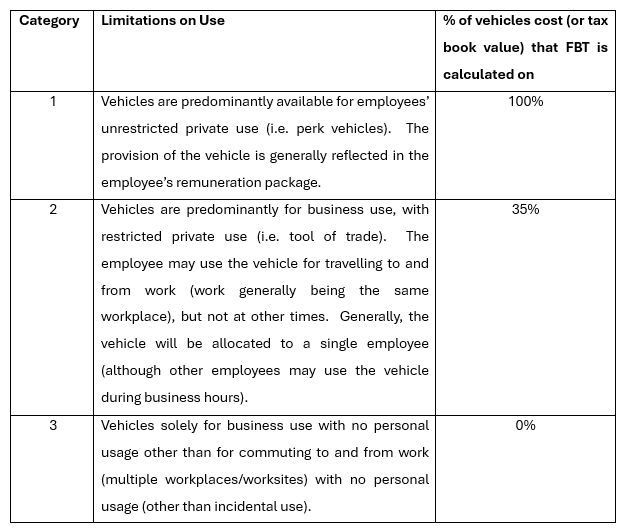
You will note that category 3 vehicles result in no FBT liability. The relevant factors that would need to be considered to fit into this category are:
- Can be used for home-to-work travel, and that workplace generally varies depending on where the worker is required (i.e., different worksites rather than a central office, although this may include the same worksite when the employee is on a project of a limited duration)
- No other private use is permitted at any time, except incidental use
- The vehicle is used as part of delivering the services of the employer
- The vehicle is permanently branded with the employer’s logo
Despite the “work-related vehicle” exemption being removed, the requirements to fit within category 3 are very similar to the “work-related vehicle” exemption. Category 3 is available for all types of vehicles, whereas the “work-related vehicle” exemption is not available for a car.
There is a further proposal that a vehicle used by a shareholder-employee, which is available for private use, would be a category 1 vehicle if the cost of the vehicle was $80,000 or more. Inland Revenue’s has included this in the proposals as an integrity measure as they do no not want shareholder-employees purchasing vehicles that are considered “luxury” for a business and claim that one of the lower categories apply. It is this proposal that also has some hot under the collar.
Under the proposals, if a ute costs $80,000 or more, and is used by a shareholder-employee, the ute will not be subject to FBT if it is not available for private use. It is the availability of the ute for private use that matters. Under current rules, if a ute is available for private use (other than to and from work) by a shareholder-employee, it is subject to FBT and FBT would be payable on 100% of the ute’s cost or tax book value. Under proposed rules, if a ute is available for private use by a shareholder-employee, it is subject to FBT and FBT would be payable on either 0%, 35%, or 100% of the ute’s cost or tax book value (100% if the ute costs $80,000 or more). This shows that the proposed rules are more favourable than the current rules for utes.
The big elephant in the room, which very few are willing to acknowledge, is that FBT is considered one of the least complied with taxes as taxpayers believe the way in which FBT is calculated is unfair. Due to this “unfairness”, there will be taxpayers who are not paying FBT on vehicles even though they are available for private use. Inland Revenue’s proposals are aimed at removing the elephant from the room by having FBT on vehicles calculated more in line with the actual private use of the vehicle, which in turn will reduce some employer’s FBT liability, which should then result in non-compliant taxpayers paying FBT.
If the proposals proceed, we would expect to see increased FBT audit/review activity from Inland Revenue to enforce compliance under the new rules.
There are some small changes we would like to see made to the proposals however, overall, we believe the proposed FBT changes are a positive for taxpayers.

Brad Phillips
PrincipalArmed with an extensive knowledge bank, Brad specialises in providing taxation services to clients in the corporate, business, and rural sectors. He also has a keen interest in valuation, asset protection, and estate planning matters.

 Brad Phillips
 Sarah Hopkins

 Grace Dawson